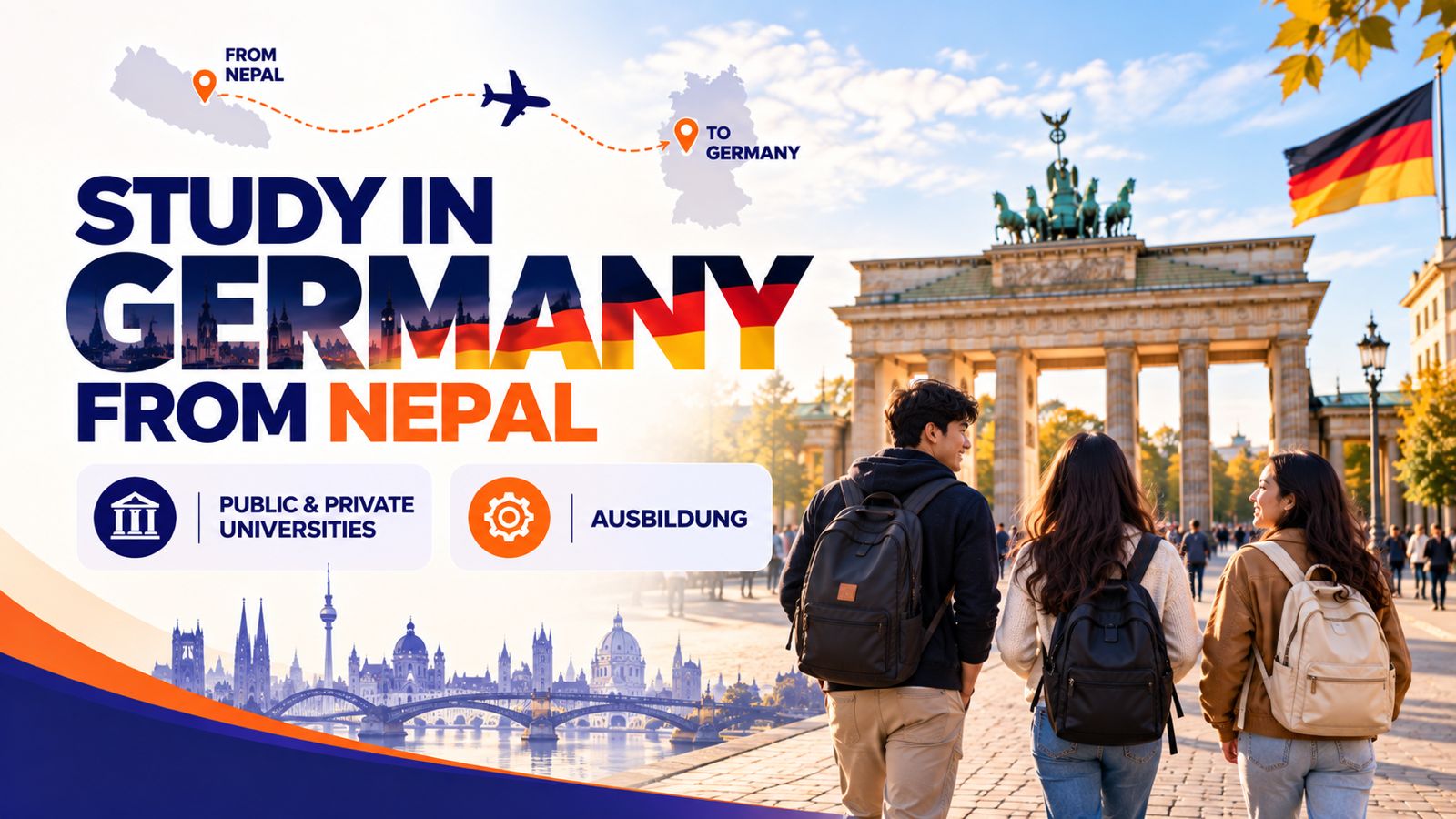
Germany is one of the founding members of the European Union, it works as a guarantor of peace, prosperity and security. The Federal Republic of Germany is situated in the heart of Europe and is also the Europe’s largest economy and a global leader in technology, healthcare, engineering and research. It is also known to offer world class public universities that is tuition-free higher education, as well as world class Ausbildung (Vocational Training). Germany’s stable employment market attracts many career opportunities around the world, especially for the Nepali students who are looking for a tuition-free higher education, quality education and direct placement opportunities.
Study in Germany
Why is Germany one of the best destinations for Nepalese students
- Tuition-Free Higher Education: In most of the public universities across Germany charge €0 tuition fees for the international students (except in the case of Baden-Württemberg, in which the non-EU fees are around €1,500/semester). The students generally pay nominal administrative semester fees of €150-€400.
- Earning While Learning: During the dual vocational training system (Ausbildung) students work for a German employer while also studying at a vocational school (Berufsschule). Students can generally expect a monthly stipend of (€800-€1,300) which can cover their living expenses.
- Working Rights: The university students can work up to 140 full days or 240 half days as per the calendar year during their studies.
- 18-Month Post-Study Job Seeker Visa: University graduates are eligible for an 18-month job seeker residence visa, and Ausbildung graduates have direct access to skilled employment and residence permits.
- Permanent Residency: Fast-track settlement permits are available after 2 years of working after the post-graduation or after completion of an Ausbildung and working in the profession.
Popular course for Nepalese students
- Degree Programs
- Engineering and Technology: Automotive, Mechanical, Renewable Energy, Civil and Electrical Engineering.
- Information Technology and Computer Science: Software Engineering, Data Science, Cyber Security and Artificial Intelligence.
- Business and Economics: International Management, Supply Chain and Logistics, and Finance.
- Biomedical Sciences and Biotechnology: Environmental Technology and Molecular Life Sciences.
- Ausbildung (Vocational Training)
- Nursing and Healthcare: Consists of excellent stipends, is highly demanded and rapid visa processing.
- Hospitality: Hotel management, restaurant management and culinary preparation.
- Information Technology: System integration, development of software and digital networking.
- Electrical and Mechatronics: Automation, robotics and automotive mechanics.
Popular and Affordable German Universities for Nepalese students
- Technical University of Berlin: It is a highly popular public university that is located in Germany’s capital, offering zero tuition fees and an extensive collection of English taught Master’s options.
- University of Bonn and University of Cologne: Major public research universities located in North Rhine-Westphalia with vibrant student communities and zero tuition fees.
- Ludwig Maximilian University of Munich (LMU Munich): Ranked among the Europe’s top universities that provides tuition-free education in a major industrial hub.
- Technical University of Munich (TUM): World renowned technical university, TUM recently introduced modular tuition fees for non-EU students for specific programs but remains highly sought after.
- RWTH Aachen University: It is one of Germany’s oldest universities and is known as being one of Germany’s top engineering and technology hubs, which offers zero tuition fees and high industry employability.
- Applied Sciences Universities (e.g., Fulda University of Applied Sciences, TH Deggendorf): It is an excellent choice for a practical oriented degree with a low semester contribution and a highly local job placement rate.
Public Vs Private Universities in Germany: Key Features and Difference in Fees
Key Features:
| Feature | Public Universities | Private Universities |
| Funding | State funded and subsidy | Privately owned or backed by corporates |
| Language of Instruction | Mostly German (Bachelors); English or German (Masters’s) | Mostly taught in English across all the levels |
| Cohort Size | Large, around 100-300+ students per lecture | Small, around 15-30 students per class |
| Admission Process | Competitive; strict GPA and subject criteria required. | Usually flexible with holistic evaluation and interviews |
| Practical Focus | Theoretical and research oriented | Applied, project-based corporate ties. |
Fee Difference:
- Public Universities: Most of the public universities charge €0 tuition fees. Students only need to pay the mandatory semester contribution ranging from €150 to €400 per semester (around NPR 26,338 to NPR 70,236), which would also cover the administrative costs and regional public transport pass.
- Certain Exceptions: Some universities such as the state of Baden-Württemberg charge the non-EU international students with €1,500 per semester and the Technical University of Munich (TUM) levies the tuition fees for non-EU students which can range from €2,000 to €6,000 per semester depending upon the program.
- Private Universities: The private institutions charge full tuition fees, which can average between €8,000 to €20,000 per year (around NPR 14,04,720 to NPR 35,11,800). Certain MBA programs can even exceed €30,000 (around NPR 52,67,700) per year.
Top Private Universities in Germany for Nepalese Students
- GISMA University of Applied Sciences: A modern private University with a practical focus in Software Engineering, Leadership and Business Analytics, located in Germany’s tech and startup hub, with a special career integration programme for international students.
- University of Europe for Applied Sciences (UE): An internationally oriented private university known for creative, business, technology, and design-focused programs, with an emphasis on practical and industry-relevant learning.
- Arden University Berlin: A flexible, career-focused university offering English-taught undergraduate and postgraduate programs in areas such as business, computing, and management, with a strong focus on employability.
- Berlin School of Business and Innovation (BSBI): A private higher-education institution focused on business, management, finance, marketing, and related disciplines, offering internationally oriented programs in Berlin.
- Media University of Applied Sciences: A specialized private university focused on media, communication, management, psychology, design, and digital business, combining academic learning with practical industry skills.
Top 5 popular German cities for Nepalese student
- Munich: The city of Munich is a top spot for Nepali students offering academic excellence, rich culture, and an exceptional quality of life. Munich boasts around 20 universities including globally respected universities such as Technical University of Munich (TUM) and the Ludwig Maximilan University of Munich. The cost of living, however, is high with an expected budget of around €1,045 per month in order to cover the expenses.
- Berlin: It is the capital city of Germany with a booming tech startup scene, a multicultural environment for Nepali students and consists of top universities, such as the tuition-free University of Berlin.
- Aachen: Home to the RWTH Aachen University and four other institutions offering 78 programs including English combined, it consists of rich history, high quality of life and most importantly affordability.
- Leipzig: Known for having low living costs, relatively large student populations and a growing number of technology parks.
- Stuttgart: It is one of the major industrial and financial hubs that offers extensive part-time and career opportunities for the Nepalese students.
Types of Course
- Preparatory Course (Studienkolleg): It is a mandatory foundation program for Nepalese students who completed class 12 (+2) and need to get aligned with the academic system before taking admissions in German university bachelor programs. It concludes with a Feststellungsprüfung (FSP) exam.
- Undergraduate Degree or Bachelor’s: Usually of 3-to-4-year programs (B.Sc., B. Eng., B.A.) that focuses on scientific and applied theory.
- Postgraduate Degree or Master’s: Usually of 1.5-to-2-year specialized degree programs (M.Sc., M.Eng., M.A.) that usually requires a relevant bachelor background.
- Ausbildung (Dual Vocational Training): It is a 2-to-3.5-year structured apprenticeship type program that combines practical workplace training with a certified company (usually 3-4 days per week) and theoretical lessons that take place at the vocational school (1-2 days per week)
- Doctorate Studies or PhD: Usually of 3-to-5-year research-based programs, which is fully funded through research stipends.
Academic Requirements
| Level of Course | Academic Requirement (NEB) | English Language Requirement |
| Studienkolleg | Class 12/+2 minimum GPA 2.8+ | German Level B1/B2 (Goethe/telc) |
| Undergraduate (UG) | Class 12/+2 and 1 year of bachelors in Nepal or Studienkolleg FSP with a minimum GPA of at least 2.5 to 2.7 | German C1 or IELTS 6.5 (for English taught courses) |
| Postgraduate (PG) | 4-year bachelor’s degree with a strong GPA | IELTS 6.5-7.0 or German B2/C1 (depending on course language) |
| PhD / Research | Relevant master’s degree with strong GPA + detailed Research Proposal | German Level B1 or B2 (Goethe or telc) |
German University Application Process
Path A: University Application Process
- University Selection & Uni-Assist: Make a shortlist of universities and apply through the central application service (uni-assist) or directly to the university.
- Document Verification: At the German Embassy portal apply for document verification.
- Receive Offer Letter (Zulassungsbescheid): Obtain your official admission letter.
- Open Blocked Account (Sperrkonto): Keep the necessary annual living maintenance sum (€11,904) in an approved provider (e.g. Expatrio, Fintiba.)
- Book Visa Appointment: Make a visa appointment at VFS Global, Kathmandu.
- Visa Processing and Travel: Go to the appointment and receive your Type D National Visa, as well as collect your biometrics and travel to Germany.
Path B: Ausbildung Application Process
- German Language Mastery: Certified B1 or B2 level in German from a recognized testing center (Goethe-Institut, ÖSD, or telc).
- Document Preparation: Create a German standard resume (Lebenslauf) and motivation letter (Motivationsschreiben) and translate academic credentials.
- Seek work with employers: Go directly to the employers via the German job portal Ausbildung.de or the Make-it-in-Germany portal, or through an education center authorized by the employers.
- Interview & Contract: Interview & sign an Ausbildungsvertrag (Apprenticeship Contract) with German employers and prepare a training plan.
- Federal Employment Agency Approval (Bundesagentur für Arbeit): Employer receives a preliminary approval from the Federal Employment Agency.
- Visa Application: German National Visa for Vocational Training from Visa Foreign Service (VFS) Global Kathmandu.
Type of Scholarships
- DAAD Scholarships: prestigious German Academic Exchange Service scholarships for full monthly stipend, travel allowance and health insurance for master’s and PhD students.
- Ausbildung Monthly Stipend: €800 to €1,400 per month (which increases every year during the training period) paid directly by your German employer.
- Deutschlandstipendium: Scholarship that fosters excellent students in Germany and is sponsored by the German State and private donors (1000 monthly payments of €300).
- The Heinrich Böll & Friedrich Ebert Foundation: Are scholarships given to international students who have dedicated themselves to social, political and academic excellence.
Cost-break down from Nepal to study in Germany
- Pre-Departure and Administrative Expenses
| Items | Cost in Euros | Cost in NPR |
| German National Visa Fee (Type D) | €75 | NPR 10,500 |
| VFS Global Service Fee | €25-€30 | NPR 3,800 |
| APS Certificate Fee (If studied in India, China or Vietnam) | Can vary | NPR 8,000, 25,000 |
| No Objection Certificate (NOC) | Nil | NPR 2,000 |
| German Language Certification | Varies depending on exam | NPR 25,000-35,000 |
| Flight Ticket | €100-€150 | NPR 15,000-22,000 |
2. Living Costs and Maintenance Funds
University Students (Blocked Account Requirement):
- €992 per month (€11,904 total per year) (Approx NPR 16.3 to 17.5 Lakhs held in a Sperrkonto).
Ausbildung Candidates:
- If your apprenticeship contract stipend is €992/month or higher, you are exempt from opening a blocked account. If the stipend is lower, you only need to block the difference.
Germany visa application process and documents check list
Germany Visa Application Process
- Get ready (3-12 months ahead of time)
- Language Proficiency: Certification (German for Ausbildung: B1/B2; German for University: IELTS 6.5+).
- APS Verification (If studied in India, China or Vietnam): academic verification on the APS platform.
- Financial Proof: Open a Blocked Account (Sperrkonto) with €11,904 (exempt if stipend obtained is at least €992 per month for Ausbildung).
- Digital Application (Consular Portal)
- VIDEX Form: Fill out the online National Visa Application (Type D).
- Consular Services Portal (Federal Foreign Office): Apply for an account on the Federal Foreign Office’s Consular Services Portal and upload digital scans of your documents for initial review.
- Appointment & Document Preparation
- Book the slot: Get appointment confirmation in German Embassy / VFS Kathmandu.
- Document Sets: Make 1 original set and 2 sets of physical photocopies (double check for order).
- Interview & Biometrics
- Attend your appointment in Kathmandu to submit physical papers, give fingerprints/biometrics, and pay the €75 visa fee in cash (NPR).
- Passport Collection & Arrival
- Visa Issuance: Pick up your stamped Type D visa (approx. 3-8 weeks).
- After arrival: Register your address in Germany (Anmeldung) within 14 days and change your visa into a long-term Residence Permit (Aufenthaltserlaubnis).
Documents Check List
- Valid Passport (minimum 12 months validity with blank pages)
- Completed National Visa Application Form (VIDEX) (printed and signed)
- APS Certificate (If studied in India, China or Vietnam)
- University Admission Letter (Zulassungsbescheid) OR Signed Apprenticeship Contract (Ausbildungsvertrag)
- Federal Employment Agency Approval (Vorabzustimmung, if provided by employer for Ausbildung)
- Proof of German Language Proficiency (Goethe / ÖSD / telc B1/B2 certificate for Ausbildung or German-taught courses)
- Proof of English Language Proficiency (IELTS / TOEFL scorecard if applying for English-taught Master’s)
- Proof of Financial:
- For Students: Blocked Account Confirmation (Sperrkonto) showing at least €11,904.
- For Ausbildung: Stipend clause in Ausbildungsvertrag showing €992/month (or top-up blocked account).
- No Objection Certificate (NOC) from MoEST Nepal
- German Standard CV (Lebenslauf) in chronological tabular format
- Motivation Letter (Motivationsschreiben) stating career goals and reasons for choosing Germany
- Academic Certificates & Transcripts (SEE, +2, or Bachelor’s marksheets, translated and legalized)
- Travel Health Insurance (valid for 3–6 months covering at least €30,000 emergency coverage)
- Biometric Passport Photographs (3 copies meeting German biometric specifications)
- VFS Appointment Confirmation Letter