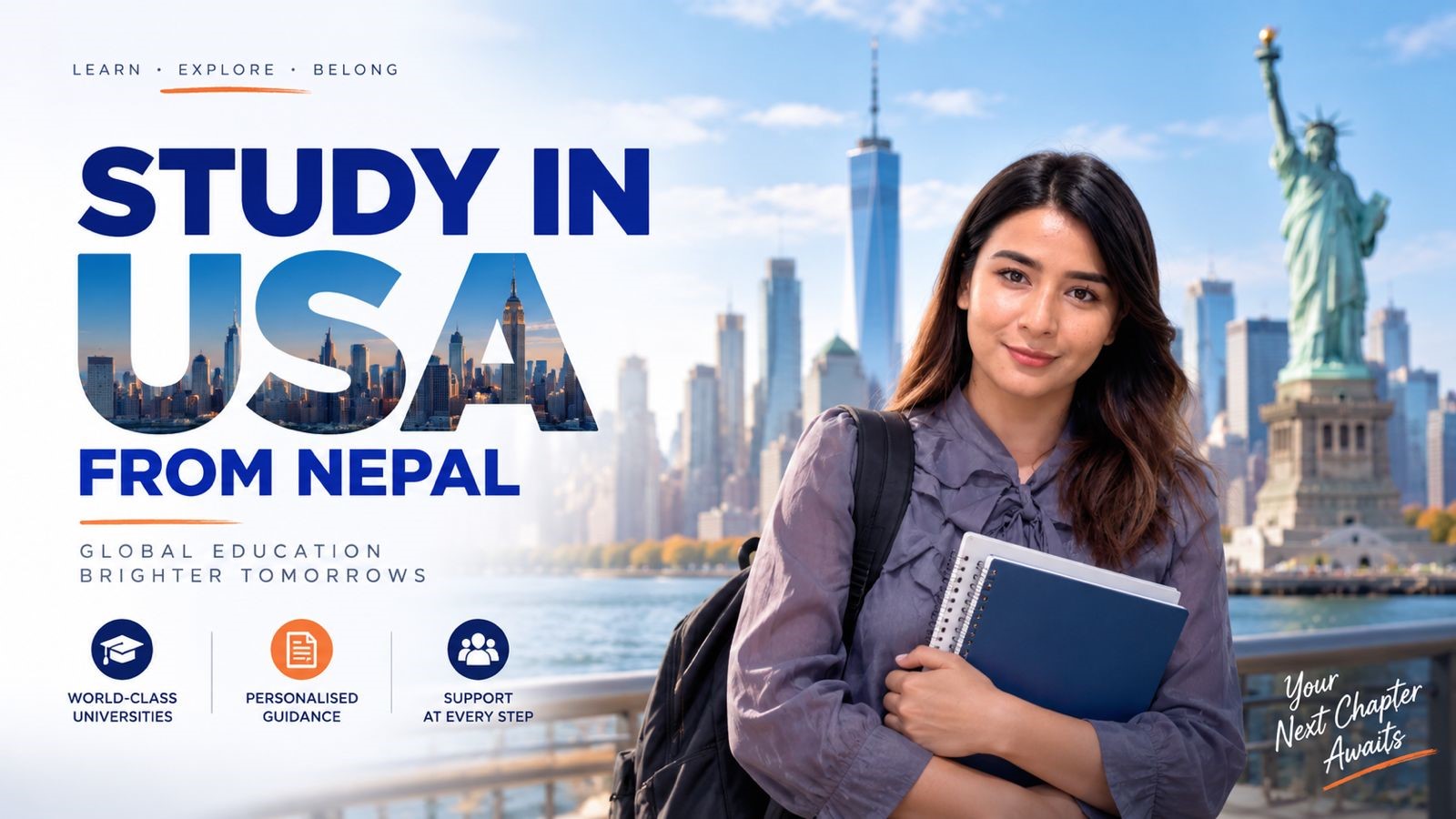
The United States of America is one of the world’s leading hubs for higher education, technological innovation and academic research. It is also home to thousands of SEVP (Student and Exchange Visitor Program) certified universities and colleges, the U.S also offers academic flexibility, top class lab infrastructure and global career opportunities. In the case of Nepalese students, pursuing higher education in the U.S provides them with access to merit-based scholarships, STEM OPT extensions (up to 3 years of post-study work permit) and overall personal and professional development.
Study in United States of America
Why the USA is one of the best destinations for Nepalese students
- Flexible Curriculum: The undergraduate students can explore major/minor fields and switch between the fields easily; they are also able to transfer credits easily between the institutions or community colleges.
- Academic Excellence: The U.S also claims to have highest concentration of top-ranked universities worldwide, that offer thousands of academic majors across undergraduate, graduate and doctorate levels.
- Financial Aid and Assistantships: Unlike the other study destinations, the U.S universities offer a substantial amount of tuition discounts, merit-based scholarships and Graduate Assistantships which cover full tuition and provide monthly stipends.
- STEM OPT Extension: Graduates at STEM (Science, Technology, Engineering and Mathematics) fields can receive 36 months of Optional Practical Training (OPT) upon postgraduation to work in the U.S corporate sector.
- On-Campus Employment: The F-1 visa holders are allowed to legally work up to 20 hours per week on campus during the academic semesters and a full time during the official summer/winter breaks.
Popular courses for Nepalese students
- Information Technology and Computer Science: Data Science, Software Engineering, Cyber Security, Cloud Computing and Artificial Intelligence.
- Engineering and Applied Sciences: Civil and Structural, Mechanical, Environmental, Electrical and Biomedical Engineering.
- Business and Management: Business Analytics, Finance, Supply Chain Management, Accounting and MBA based programs.
- Natural and Life Sciences: Biotechnology, Molecular Biology, Public Health and Environmental Science.
Popular and Affordable Universities for Nepalese Students
- University of South Florida: Very popular among Nepalese students due to automatic international merit-based scholarships (up to $12,000 per year) and relatively low living costs.
- Minnesota State University: It is recognized for its cultural diversity stipend, which reduces the student’s tuition to a near domestic rates ($10,000-$12,000 per year). Known for being strong in IT, Nursing and Engineering.
- University of Texas: Based around major technological environment with a zero-state income tax. The University of Texas also offer competitive out-of-the-state tuition waivers for high achieving international students, making the STEM based degrees affordable.
- Wichita State University: Offers flat tuition discounts and extensive on campus work opportunities in the aviation and engineering industries, which keeps the overall expenses under $22,000 per year for tuition and living expenses.
- University of Louisiana: They are known for their generous automatic merit-based scholarships that waive out of state fees for the applicants with strong high school GPAs or high SAT scores.
Top 5 popular cities in USA for Nepalese students
- Dallas/Houston (Texas): A major industrial and tech hub known for having low living costs, zero state income tax and vibrant Nepalese communities and high corporate employment rates.
- Chicago (Illinois): The financial and cultural epicenter that offers top tier research-based universities, recognizable corporate headquarters and extensive public transportation.
- Boston (Massachusetts): With over 50 higher education institutions it is known for being premier global student capital that creates unmatched academic and research network.
- Tampa/Orlando (Florida): Affordable tuition options, a booming healthcare and tech sectors alongside a pleasant climate that appeal to the standards of the Nepalese students.
- Seattle (Washington): Known for being a leading software and biotech hub which is also home to several corporate giants such as Amazon, Microsoft and Boeing, it offers strong industry exposure for the STEM students.
Types of Courses
- Associate(2years):Generally offered by the community colleges (60 credits) which prepares the students for entry level technical roles or a seamless credit transfer to the bachelor’s degree.
- Bachelor’s (4 years): These are typically a 120-credit based undergraduate degree that focuses on general education coursework alongside a specialized major study.
- Master’s (1.5 to 2 years): Generally, a professional or academic degree (30-36 credits) involving coursework and thesis research.
- Doctorate or PhD (4-6 years): Advanced degree which is typically funded by graduate research/teaching assistantships which also covers 100% tuition and living stipends.
Academic Requirements
| Level of Course | Academic Requirement (NEB) | English Language Requirement |
| Associate | Class 12/+2 minimum GPA 2.4+ | IELTS: 5.5-6.0, PTE: 45+ and Duolingo: 95+ |
| Bachelor’s | Class 12/+2 minimum GPA of 2.8+ | IELTS: 6.0-6.5, PTE: 50-58 and Duolingo: 105+ |
| Master’s (Level 8) | 4-year bachelor’s degree with a GPA 3.0+ | IELTS: 6.5-7.0, PTE: 58-65 and Duolingo: 115+ |
| Doctorate (Level 10) | Relevant bachelor’s degree or master’s degree with a background in research. | IELTS: 7.0+, PTE: 65+ and Duolingo: 115-120+ |
USA University Application Process
- Selecting and Shortlisting: Select 5-8 SEVP certified U.S universities based on the budget, location and major. Appear for the required language tests (IELTS, TOEFL, PTE and Duolingo).
- Prepare the documents: Prepare all your certified copies of academic transcripts, draft Statement of Purpose (SOP) and request 2-3 letters of recommendation from professors or employers whom you’ve worked with before.
- Submitting the application: Submit the online application forms via a particular common app or directly via the university application portals before the deadlines (Fall deadline: Nov-Feb; Spring deadline: July-Oct) and pay the non-refundable university application fees ($50-$90 depending upon the university).
- Accepting the offer: Receive and accept the offer letter and then submit the initial financial verification documents (Bank Balance proof + Sponsor Affidavit) to the university’s international student office. Finally, the university issues form I-20 (Certificate of Eligibility for Nonimmigrant Student Status) containing the SEVIS ID number.
Types of Scholarships
- Merit-Based International Scholarships: Institutional scholarships from $2,000 to $15,000 per year that are awarded automatically based on the GPA.
- Out-of-StateTuitionWaivers:Rewards or grants from state universities which offer lower in-state tuition rates.
- Graduate Assistantships (TA / RA): 100% tuition and $1200-$2500/month living stipend for master’s and PhD students.
- Fulbright Foreign Student Program: U.S. government-funded program for master’s students from abroad.
Cost breakdown from Nepal to study in USA
1. Pre-Departure and Administrative Expenses
| Items | Cost in USD | Cost in NPR |
| University Application Fees | $50-$90 | NPR 7,700-14,000 |
| SEVIS I-G01 Fee | $350 | NPR 54,000 |
| MRV Visa Application Fee | $185 | NPR 28,000 |
| English Language Tests (IELTS/PTE/SAT) | $50-$225 | NPR 7,700-34,000 |
| No Objection Certificate | Nil | NPR 2,000 |
| Flight Ticket | Varies | NPR 110,000-180,000 |
Note: The value of US dollar can change constantly depending upon the supply and demand.
2. Living Costs and Maintenance Funds
- Form I-20 Official Living Estimate: $10,000 – $18,000 per year (NPR 15 to 27 Lakhs).
- Total Estimated Cost of Attendance (I-20 COA): The student must provide liquid funds at a minimum of $25,000 to $55,000 of which consists of year 1 Tuition + Living + Health Insurance.
USA visa application process and documents checklist
USA Visa Application Process
- Review the I-20 Form: Verify all your personal details, duration of the program and estimated finance on the I-20 and then sign the page 1.
- Pay the SEVIS I-G01 Fee: Go to the fmjfee.com page and pay the compulsory $350 SEVIS fee using your SEVIS ID number, then print and save the payment confirmation receipt.
- Complete the DS-160 Form: Complete the online Nonimmigrant Visa application (Form DS-160) on the CEAC portal and then upload the compliant photo, save the confirmation page that contains the barcode.
- Pay the Visa Fee (MRV): Pay the $185 MRV visa application fee.
- Schedule Embassy Appointment: Book your visa interview at the U.S Embassy in Kathmandu via the official visa scheduling portal.
- Attend the Interview: Undergo biometric fingerprinting and present all the required documents and answer the questions regarding choice of study, career goals, financial funding and the intent to return to Nepal.
- Collection of Passport and Booking of Flights: Upon successful approval, collect your stamped passport within 3-7 business days, obtain the digital No Objection Certificate for the tuition transfer and book your flights.
Documents Checklist
- Valid Passport: Passport with clear photo of the bio-data page (must be valid for at least 6 months beyond the stay).
- Previous Passports: All previous passports with travel history, entry/exit stamps, and previous visas.
- Form I-20: Original, signed Form I-20 issued by your SEVP certified institution.
- Admission Letter: Acceptance letter from the university.
- DS-160 Confirmation Page: Printed Confirmation Page with a barcode.
- SEVIS I-G01 Fee Receipt: Printed payment confirmation receipt ($350).
- MRV Visa Fee Receipt: Printed confirmation of the payment receipt ($185).
- Nepalese Citizenship Card (English): English translation of Nepalese citizenship card.
- Birth Certificate s Relationship Certificates: Certificates provided by the municipal ward and linkage to sponsors and applicants by birth certificate.
- Academic Credentials: Marksheet, Migration Certificate, Character Certificate and Pass Certificate.
- Language Test Report: Official certificate for IELTS, TOEFL, PTE or Duolingo.
- Statement of Purpose (SOP) s Resume: Statement outlining goals, university selection reasons, and plans in Nepal, along with CV.
- Work Experience Proof (If Applicable): Experience letters, appointment letters, and pay slips for post-graduation employment.
- Proof of Financial Funds: Bank balance certificate + 3 to 6 months bank statements/ Class ‘A’ education loan sanction letter for Year 1 COA.
- Financial Sponsor Documentation: Sponsor Affidavit of Support, Ward Income Verification Certificate, Salary Letter, Tax Receipts, Business Registration, or Audit Report.
- No Objection Certificate (NOC): Online approved digital No Objection Certificate from Ministry of Education Science and Technology (MoEST) Nepal.