
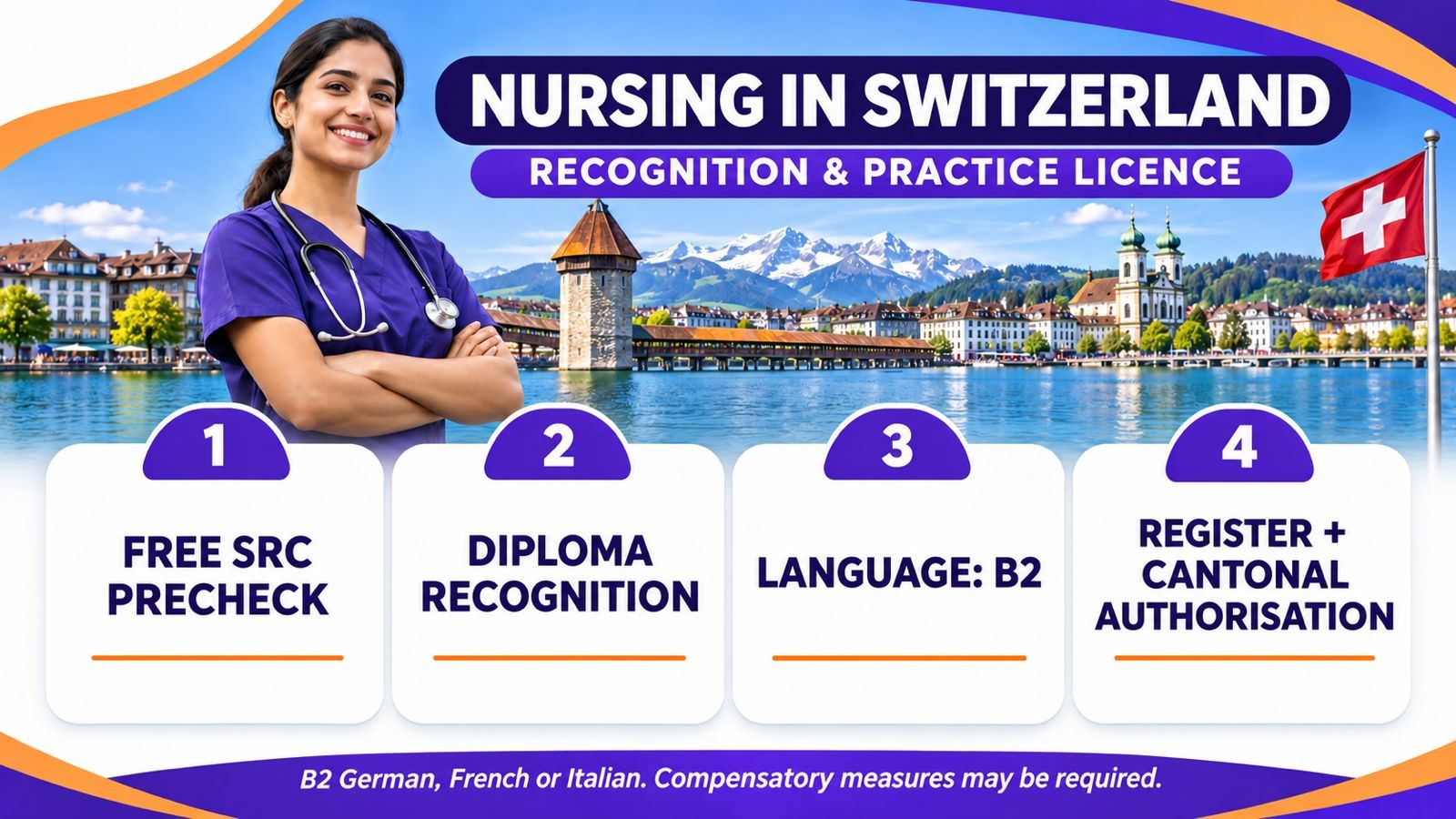
A nursing career in Switzerland gives access to one of the world’s most advanced and highest paying healthcare systems. Nursing practice is also strictly regulated across Switzerland’s 26 cantons, with the national credential recognition governed by the Swiss Red Cross which is in coordination with the Federal Office of Public Health.
Academic and Language Requirements
The nursing qualifications in Switzerland are mainly offered through universities of applied sciences.
- Bachelor of Science in Nursing: Usually for 3 years with the standard pre-registration program combining academic theory, simulation tab training and mandatory clinical rotations in regional acute and long-term care facilities.
- Master of Science in Nursing: Generally, for 1.5 to 2 years and is designed for advanced clinical practice, research or leadership tracks.
Language Requirements
The candidates must be able to showcase minimum B2 to C1 proficiency in the official language of the canton where they intend to study or practice:
- German Speaking Cantons (e.g. Zurich, Bern, Basel): Goethe, telc or OSD certificate (B2/C1).
- French Speaking Cantons (e.g. Geneva, Vaud): DELF/DALF certificate (B2/C1).
- Italian Speaking Canton (Ticino): PLIDA or CELI certificate (B2/C1).
Swiss Red Cross Protocols
In order to practice as a registered nurse in Switzerland the diploma must be formally recognized by the Swiss Red Cross in order to obtain the license.
Path 1: Swiss Graduates
The Swiss graduates follow a direct registration process:
- Institutional Verification: The university will certify the completion of academic and clinical credit requirements directly to the SRC.
- Exemption from Exams: The graduates do not need to take any additional equivalency tests.
- NAREG Registration: The graduates will need to enter the details into National Register of Healthcare Professions (NAREG) and obtain their official license.
Path 2: Third Country Graduates
Nurses that hold foreign diplomas will have to undergo the evaluation done by the Swiss Red Cross:
- SRC Pre check: Submit your initial documentation online and determine eligibility.
- EU/EFTA Diplomas: They are automatically recognized under the bilateral agreements upon showing proof of cantonal language skills.
- Non-EU Diplomas: They are evaluated under the general system and if training gaps are identified the applicants must complete compensatory measures, either an adaptation period or aptitude test in Switzerland.
Pay Scales, Work Permits and Career Prospects
The EU/EFTA citizens are granted simplified access under the agreement on Free Movement of Persons. For the non-EU citizens, they are subject to strict cantonal labor quotas, and the employers will have to prove that no local or EU candidate could be found for the role.
- Pay Scales: The registered nurses in Switzerland earn among the highest salaries globally and it starts with compensation ranging from CHF 75,000 to CHF 95,000+ per year and vary depending upon the canton and experience level.
- Permanent Residency: The EU/EFTA nationals can apply for a C permit after 5 years of continuous stay. The non-EU nationals will generally qualify after 10 years (can be reduced to 5 years under successful integration programs).